Toyota RAV4 vs Honda CR-V: Which SUV Fits Your Family?
Compare the 2026 RAV4 and CR-V for hybrid choices, family space, charging needs, equipment, and ownership checks without mixing vehicle generations.

What to know first
- The 2026 RAV4 introduces a new generation; verify the model year and market in every specification.
- Distinguish hybrid, plug-in hybrid, gasoline, and drivetrain configurations before comparing.
- Evaluate child-seat fit, cargo needs, charging access, and the exact vehicle history.
Start with the 2026 RAV4 if you want to compare Toyota’s new-generation hybrid and plug-in-hybrid options. Start with the 2026 CR-V if you want a choice between conventional gasoline and hybrid configurations. For most families choosing between the regular hybrids, the deciding evidence will be child-seat fit, cargo access, the actual equipment list, and a comparable purchase quote.
This Toyota RAV4 vs Honda CR-V comparison covers the 2026 U.S. buying decision. The RAV4 enters a new generation for that year. A bargain on an outgoing RAV4 may still be attractive, but it is a different comparison; do not carry its specifications into a 2026 worksheet.
New-generation 2026 RAV4 Woodland photographed at a dealership in the Philippines. This illustrates exterior design, not U.S. trim equipment, pricing, or specifications. Photo: Captainmorlypogi1959; CC BY-SA 4.0. Converted to WebP by RecallWire; original framing retained.

Match the year and powertrain first
| Family-shopping question | 2026 RAV4 | 2026 CR-V |
|---|---|---|
| Main powertrain decision | Hybrid or plug-in hybrid | Gasoline or conventional hybrid |
| Need to plug in a regular hybrid? | No | No |
| Important generation check | New generation for 2026 | Verify the selected 2026 trim and drivetrain |
| Best direct comparison | Regular hybrid against a similarly equipped CR-V hybrid | Hybrid against hybrid; gasoline separately if purchase budget is central |
| Equipment to verify | Seats, displays, driver assistance, cargo setup, and accessories | The same items, using the actual trim specification |
Toyota’s 2026 RAV4 press kit identifies the new lineup; Honda’s 2026 CR-V pricing and EPA table separates its gasoline and hybrid versions. A CR-V LX and a RAV4 plug-in hybrid solve different purchasing problems. Comparing the cheapest price from one with the most capable powertrain from the other will not produce a useful winner.
Write the full configuration across the top of each quote: year, trim, powertrain, driven wheels, and major packages. That small step prevents most misleading comparisons later.
Decide whether plugging in helps your household
A regular hybrid is the simpler starting point if you want improved fuel efficiency without arranging charging. It still uses gasoline. A plug-in hybrid adds a charging decision: whether you can regularly replenish its battery and use that electric driving for the trips you actually make.
The question is not merely whether an outlet exists somewhere. Can you park near a suitable charging location reliably? If you rent, will the arrangement remain available? Will another household vehicle need the same space? Include any electrical work in the purchase budget. The Department of Energy’s home-charging guidance explains the infrastructure considerations.
For a RAV4 plug-in-hybrid candidate, check the exact battery, charging, and range specifications for that trim. Do not assume the regular hybrid’s figures apply. If you expect to leave the car unplugged most of the time, evaluate whether the extra purchase cost and equipment serve another meaningful need.
If both SUVs on your list are regular hybrids, set the charging question aside and concentrate on everyday fit. A family’s school run does not become easier because a brochure contains a powertrain option the household cannot use.
Read fuel economy as a configuration-specific fact
Honda lists 40 EPA-estimated combined mpg for the 2026 CR-V Sport Hybrid 2WD and 37 for the AWD version. The TrailSport Hybrid AWD has a different 35-mpg combined rating. The LX gasoline ratings are 30 combined for 2WD and 29 for AWD. These are selected examples, not one rating shared by every CR-V.
Toyota’s 2026 RAV4 launch material describes up to 44 manufacturer-estimated combined mpg for a front-wheel-drive hybrid configuration. That particular launch estimate is not presented here as a matched EPA result against Honda’s published EPA table. Confirm the current fuel-economy label for the specific RAV4 you are considering.
You can still make a useful within-lineup calculation. At an assumed 12,000 annual miles and $3.50 per gallon, a 40-mpg CR-V would use about $1,050 of gasoline; a 30-mpg CR-V would use about $1,400. The $350 modeled annual difference is energy only, and the trims also differ in equipment and price.
This illustrates why a hybrid premium needs an ownership horizon. A few hundred dollars in annual fuel savings cannot justify an unspecified price difference by itself. Equally, a household with very high annual mileage should use its own mileage rather than a generic example.
Make the rear seat pass a real family test
Bring the child seats and the people who will use the SUV. Set the front seats to the positions the actual drivers need, then install the restraints according to the vehicle and restraint instructions. Check access to the permitted attachment points and whether another passenger can sit comfortably beside the installation.
If a rear-facing seat forces the front passenger into an uncomfortable position, the advertised passenger-volume figure has not solved your problem. If you need to help a child buckle in daily, test the door opening and your reach from outside the vehicle.
For older passengers, check seat height, foot space, and ease of entry. A vehicle that suits two small children may not suit an adult who regularly sits in the rear. A taller roof is helpful only if the seating position and opening also work.
Use the same sequence in the RAV4 and CR-V. It gives you observations you can compare, instead of a memory of which showroom felt larger. The result may favor one exact trim or roof configuration rather than the entire model line.
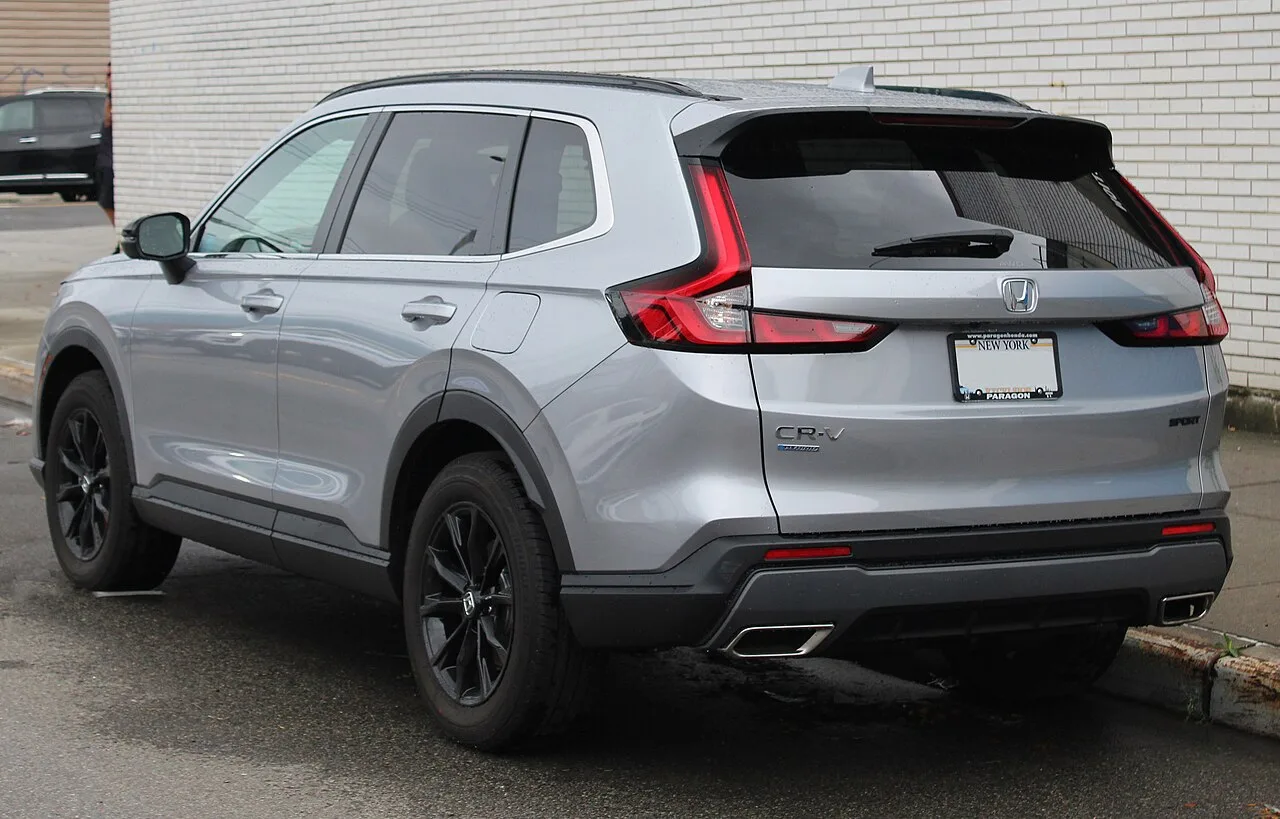
Photo: Kevauto; CC BY-SA 4.0. Converted to WebP by RecallWire; original framing retained.

Check cargo shape and access
Published cargo volume can help narrow the shortlist, but loading conditions and measurement methods affect interpretation. Check whether a figure describes space behind the rear seat, space with seats folded, or another arrangement before placing numbers side by side.
The more revealing test uses your belongings. Bring the stroller, folded mobility aid, dog crate, or sports equipment that determines whether the SUV works. Check the liftgate opening, floor height, and whether the rear seat must be folded to fit an ordinary load.
Consider the people and cargo together. A weekend trip with occupied rear seats is different from carrying a large item alone. If the cargo cover must be removed, decide where it will go. If a load blocks visibility, plan how to secure it and keep the required sight lines clear.
Roof racks, cargo boxes, and hitch accessories create another decision. They add cost and weight and may introduce their own limits. Neither AWD nor an outdoors-oriented trim name establishes how much the specific SUV can safely carry or tow.
Treat labels and towing limits as part of the purchase
Check the selected vehicle’s towing documentation if you plan to pull a trailer. Determine which equipment is required, what the trailer weighs when loaded, and how passengers, luggage, and tongue load affect the vehicle’s remaining carrying capacity. A sales claim of “available towing” is not enough.
The door labels matter for family travel too. Factory and dealer-installed equipment can change available load capacity. RecallWire’s limited Toyota accessory-weight-label campaign includes specified 2026 RAV4 Hybrid vehicles among other Toyotas. The listed population is 135 vehicles across that campaign, not every RAV4.
That example illustrates a document check, not a broad judgment about SUV quality. Ask whether accessories were added and obtain the correct labels and records for the actual vehicle. If the seller cannot explain a load limit you need for your intended use, resolve the question before committing to the purchase.
For heavy or frequent towing, the right conclusion may be that neither shortlisted configuration is appropriate. Choosing the best of two unsuitable candidates does not make either suitable.
Compare safety equipment and ownership support
Use IIHS ratings and the manufacturer equipment tables for the exact year and generation. A redesigned RAV4 should not inherit a prior-generation test result in your worksheet unless the rating organization explicitly applies it. Read category details instead of assuming a single award covers every situation.
RecallWire’s pedestrian-test analysis explains why test scope matters. The article is methodological context; it is not a claim that either SUV has passed a particular new test.
For ownership, obtain insurance quotes using actual VINs and ask which routine services apply to each powertrain. Locate the service department you would use, and ask about appointment availability and transportation arrangements. A convenient service location may matter more to a busy household than a feature used twice a year.
Check applicable recalls through NHTSA and the manufacturer, then document any completed remedies. For Toyota-specific follow-up, use RecallWire’s Toyota owner guide. If shopping used, assess repair history and condition separately. Neither brand reputation nor a recall-count comparison answers the condition question for a specific vehicle.
Photo: Oregon Department of Transportation; CC BY 2.0. Converted to WebP by RecallWire; original framing retained.

Choose the SUV that passes your normal week
Choose a RAV4 hybrid candidate when its seating and cargo setup work and the selected Toyota equipment package offers the best complete quote. Consider the plug-in hybrid only after checking how regularly you will charge it and what that arrangement costs.
Choose a CR-V gasoline candidate when the purchase budget is central and the full-cost comparison supports it. Choose a CR-V hybrid candidate when your mileage and intended ownership period support the premium and its cabin passes the family test.
When both regular hybrids fit, compare the last details that affect repeated use: loading the stroller, adjusting climate controls, locating service, and paying for insurance and tires. Record those observations beside the quotes.
The useful winner is the exact SUV that transports your household comfortably within a sustainable budget. A specification advantage that does not change your daily use should not dominate the decision.
Sources and methodology
Source review: October 6, 2026. Manufacturer specifications apply to the stated model year and configuration. Illustrative calculations are identified beside the data. This guide synthesizes published documentation; it does not report hands-on vehicle testing.

Frequently asked questions
Does the 2026 RAV4 offer a regular gasoline-only model?
Toyota's new-generation U.S. lineup centers on hybrids and plug-in hybrids. An outgoing gasoline RAV4 is a different year and generation, so compare it separately.
Does the CR-V Hybrid need charging?
No. The conventional CR-V hybrid is not a plug-in hybrid. Its ownership routine does not require connecting it to an external charger.
Which SUV has more useful family space?
The answer depends on your occupants and cargo. Test the same child seats and bulky items in both. Volume figures alone cannot establish whether an opening or seating arrangement works for your household.
Sources used for this guide.
- Toyota. 2026 RAV4 press kit. Accessed October 6, 2026.Source ↗
- Toyota. 2026 RAV4 launch and estimated efficiency. Accessed October 6, 2026.Source ↗
- Honda. 2026 CR-V pricing and EPA ratings. Accessed October 6, 2026.Source ↗
- U.S. Department of Energy. Charging electric vehicles at home. Accessed October 6, 2026.Source ↗
- IIHS. Vehicle ratings. Accessed October 6, 2026.Source ↗
- NHTSA. Campaign 26V571 Part 573 report. Accessed October 6, 2026.Source ↗