Cost of Owning a Car: A Budget Beyond the Sticker Price
Build a realistic car budget covering depreciation, financing, insurance, energy, maintenance, tires, fees, and parking without counting costs twice.
What to know first
- Compare economic ownership cost over a defined period, alongside monthly cash flow.
- Avoid counting both the full purchase price and depreciation in the same ownership total.
- Use actual financing and insurance quotes; the example budget is hypothetical.
The cost of owning a car includes the vehicle’s loss in value, financing, insurance, fuel or electricity, maintenance, tires, fees, and the costs of storing and using it. Your monthly loan payment is one cash-flow item, not a complete ownership estimate. A useful budget keeps monthly affordability separate from the economic cost over the years you plan to own the vehicle.
This guide gives you a worksheet and a clearly labeled five-year example. The example uses assumed amounts to demonstrate the accounting; it is not an average ownership cost or a prediction for a particular model. Replace the assumptions with written purchase terms, insurance quotes, your mileage, and vehicle-specific service information.
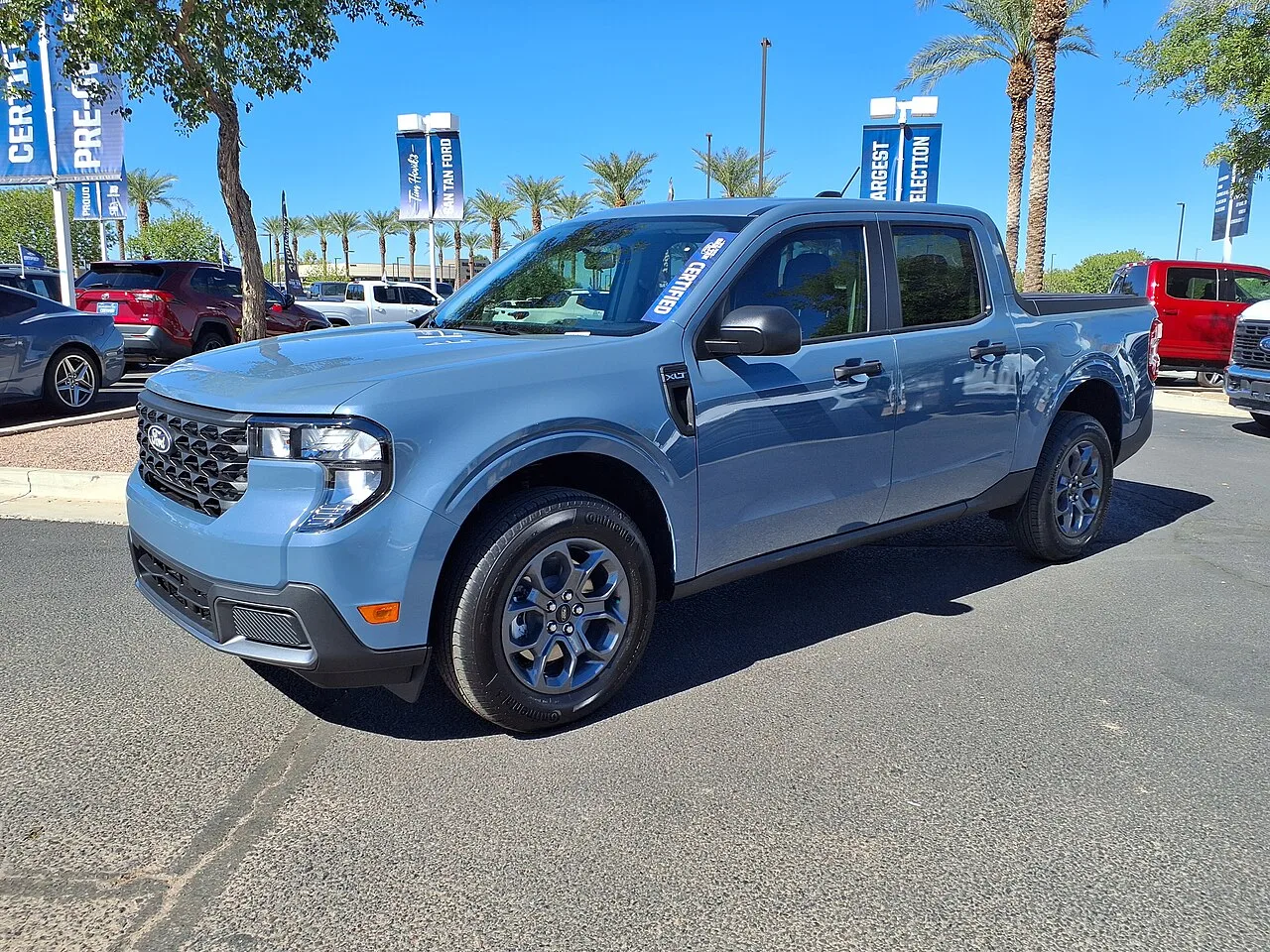
A compact pickup illustrates the purchase side of an ownership budget. The five-year example below is not a Maverick estimate. Photo: HJUdall; CC0. Converted to WebP by RecallWire; original framing retained.

Choose the question your budget will answer
There are two useful questions. Cash flow: can you pay the bills when they arrive? Economic cost: how much does using this vehicle cost over the ownership period after accounting for its remaining value?
For cash flow, list your down payment, loan payments, insurance schedule, registration, energy spending, and service bills. A payment due every month and a tire purchase due once every few years affect your bank account differently.
For economic cost, use purchase cost minus net sale proceeds as depreciation, then add interest and operating expenses. Do not also add the full repaid loan principal. Principal helped purchase an asset whose decline in value is already included.
Both views are necessary. A car can have a reasonable five-year cost but an unaffordable down payment. Another can offer a low monthly payment while a long loan and accumulated interest make the complete purchase expensive. The CFPB’s auto-loan resources help evaluate the financing side.
Start with the complete acquisition price
Get an itemized out-the-door quote. Identify the vehicle price, taxes, title and registration costs, dealer fees, and optional accessories or products. Record each item once in your worksheet.
If you place acquisition taxes and fees in the starting purchase basis used for depreciation, do not add them again in the operating-expense column. Alternatively, track them separately, as the illustration below does. The choice matters less than using it consistently.
Treat a trade-in as a separate transaction. Record the offered value and any outstanding loan payoff. Rolling an old balance into a new loan affects financing and cash flow; it does not improve the new vehicle’s underlying value.
Compare financing with the same ownership horizon. Record the APR, financed amount, term, and total interest expected during that period. A rate offer that requires an expensive optional product needs to be evaluated with the product included. The CFPB’s key-terms guide explains the relevant loan vocabulary.
Model depreciation with more than one resale assumption
Depreciation is often uncertain because the future sale price is uncertain. Start with a reasonable planning estimate, then test a lower one. Use the same intended holding period and annual mileage for each vehicle.
In an illustrative five-year scenario, a vehicle costs $28,000 before the separately tracked taxes and fees and is sold for $16,000 net. The modeled depreciation is $12,000. If net sale proceeds were only $13,000, depreciation would be $15,000 instead, adding $600 per year to the five-year cost.
This is not a forecast about the market. It shows the sensitivity of your budget. A small apparent fuel advantage can be outweighed by a modest error in resale assumptions.
For a financed vehicle, compare expected sale proceeds with the balance due at that time. Proceeds used to repay the loan are not all available as spending money. In the cash-flow view, account for the payoff; in the economic view, keep the vehicle’s value loss and interest clear.
Get insurance and energy costs for the actual vehicle
Obtain insurance quotes using the VIN or precise configuration, with the same driver information, limits, deductibles, and coverage types. A brand-level average cannot establish what your household will pay. Ask whether financing requires coverage you did not carry on your previous vehicle.
For gasoline, calculate annual miles divided by realistic mpg, multiplied by your planning fuel price. For electricity, calculate annual wall-energy consumption multiplied by the rates you expect to use. The EPA vehicle comparison tool provides configuration-specific efficiency information.
Separate home and public charging when their prices differ. Include session fees or subscriptions you actually intend to buy, and keep installation in its own cost category. The DOE home-charging guide describes the infrastructure questions that can require an installation estimate.
Parking and tolls deserve equal attention. If you pay to park near work or at home, those costs may exceed the fuel difference between two shortlisted cars. Include regular car washing or other services if they are part of your actual routine rather than calling every nonessential item unavoidable.
Plan maintenance, tires, and irregular bills
Use the exact manufacturer schedule to identify expected services. Ask a service provider for prices on work likely during your intended ownership period. For a used vehicle, distinguish an immediate repair identified at inspection from a future reserve for unknown repairs.
Tires need their own allowance if they are not included in your maintenance estimate. Check replacement prices for the actual size and type. A more expensive trim’s wheels can change this expense even when the engine is identical. NHTSA’s tire guidance covers tire care and inspection considerations.
A reserve is money set aside, not necessarily money spent. If you put $100 a month into a repair account and later pay a $900 repair from it, the economic expense is the $900 repair; counting the deposits and the repair would count that spending twice. In cash flow, the deposits still help you prepare for the bill.
Review any service contract separately. The FTC warranty guide explains the distinction between warranties and service contracts. If a contract is purchased, record its price and do not also assume it pays for every expense already in your maintenance column.
Photo: Martin Vorel; CC BY-SA 4.0. Converted to WebP by RecallWire; original framing retained.

Use this five-year example without double-counting
All amounts below are editorial assumptions for one hypothetical vehicle over five years. They are not market averages, quotes, or projected costs for the photographed pickup.
| Economic-cost category | Five-year assumption | Calculation or scope |
|---|---|---|
| Depreciation | $12,000 | $28,000 purchase minus $16,000 net sale proceeds |
| Financing interest | $2,500 | Assumed interest paid during the period; principal excluded |
| Insurance | $10,000 | $2,000 a year |
| Fuel or electricity | $7,000 | $1,400 a year |
| Maintenance, tires, and actual repairs | $4,500 | Assumed combined spending; reserves excluded |
| Taxes, registration, and fees | $2,500 | Separately tracked; excluded from the $28,000 purchase basis |
| Parking and tolls | $3,000 | $600 a year |
| Total | $41,500 | $8,300 a year, or about $692 a month |
Graphic and table: RecallWire editorial assumptions and arithmetic. This economic-cost example excludes opportunity cost, charging installation, and costs not listed. It is not a monthly bill schedule.
The total is $41,500. Changing the resale assumption to $13,000 raises it to $44,500. Replacing the energy estimate with your own figure may move it in either direction. These sensitivities tell you which quotes and assumptions deserve the most effort.
Build a cash plan alongside the cost estimate
Now make a calendar for the same hypothetical vehicle. Record the actual down payment and monthly loan schedule you would accept. Add recurring bills and the months in which registration, insurance renewals, and planned maintenance fall due.
Create a sinking fund for irregular expenses. Divide an expected tire bill by the months remaining until replacement, for example, rather than discovering the entire bill when the tread is worn. Keep an emergency reserve distinct from predictable scheduled work.
If cash is tight, test the budget against a higher insurance quote or earlier repair. A five-year average can hide a difficult first year, particularly when a purchase, taxes, and immediate used-car maintenance arrive together.
Recall remedies are a separate category from ordinary upkeep. RecallWire’s F-150 fuel-tank campaign describes a no-charge remedy for eligible vehicles. That does not make unrelated service free. Ask about transportation and scheduling for applicable campaigns rather than assuming there is no practical time cost.
Compare cars using the same worksheet
Give each shortlisted vehicle the same ownership period, annual mileage, insurance coverage, and accounting treatment. Change only the inputs that legitimately differ: purchase terms, energy consumption, service needs, tire prices, and supported resale assumptions.
Keep a note beside every uncertain amount stating how you obtained it. “Insurance quote dated October 6” is stronger than “this brand is cheap to insure.” “Planning resale assumption” is more honest than presenting a future value as established fact.
For model ideas, use RecallWire’s 2026 value-vehicle shortlist after setting the budget. Its model suggestions do not replace your calculations. For service logistics, the Rivian camera-recall analysis illustrates why a software remedy still needs completion verification; it does not establish Rivian ownership costs.
Choose the vehicle whose bills you can manage and whose complete cost remains reasonable under a less favorable scenario. A sustainable budget leaves room for owning the car after you buy it.
Sources and methodology
Source review: October 6, 2026. Manufacturer specifications apply to the stated model year and configuration. Illustrative calculations are identified beside the data. This guide synthesizes published documentation; it does not report hands-on vehicle testing.

Five-year ownership cost: an illustrative scenario
Depreciation: $12,000; Insurance: $10,000; Energy: $7,000; Maintenance, tires, repairs: $4,500; Parking and tolls: $3,000; Financing interest: $2,500; Taxes, registration, fees: $2,500. See the visible article table for assumptions and sources.
USD/5 years · Hypothetical vehicle · $41,500 total economic cost. Excludes opportunity cost, charging installation, and unlisted expenses.
View data table
| Label | Cost | Note |
|---|---|---|
| Depreciation | 12000 | Selected configuration; see article assumptions and citations. |
| Insurance | 10000 | Selected configuration; see article assumptions and citations. |
| Energy | 7000 | Selected configuration; see article assumptions and citations. |
| Maintenance, tires, repairs | 4500 | Selected configuration; see article assumptions and citations. |
| Parking and tolls | 3000 | Selected configuration; see article assumptions and citations. |
| Financing interest | 2500 | Selected configuration; see article assumptions and citations. |
| Taxes, registration, fees | 2500 | Selected configuration; see article assumptions and citations. |
Frequently asked questions
Should I add depreciation to my full loan payments?
Not in the same economic-cost total. Loan principal purchases the asset; depreciation measures its loss in value. Track payments for cash flow, and use depreciation plus interest for the economic view.
How much should I reserve for repairs?
Use vehicle condition, inspection findings, mileage, coverage, and local estimates. There is no single amount that suits every car. Reserve deposits and actual repair spending should not both become expenses in the same cost total.
Is the example a national average?
No. Every dollar amount is assumed to demonstrate a consistent worksheet. Replace the inputs with your own evidence before using it to make a purchase.
Sources used for this guide.
- CFPB. Auto loans. Accessed October 6, 2026.Source ↗
- CFPB. Auto-loan key terms. Accessed October 6, 2026.Source ↗
- EPA. Vehicle fuel-economy comparison. Accessed October 6, 2026.Source ↗
- U.S. Department of Energy. Home charging. Accessed October 6, 2026.Source ↗
- NHTSA. Tire safety and maintenance. Accessed October 6, 2026.Source ↗
- FTC. Warranties and service contracts. Accessed October 6, 2026.Source ↗