Ford Maverick vs Hyundai Santa Cruz: Which Small Pickup Fits You?
Compare 2026 Maverick and Santa Cruz powertrains, fuel costs, bed usability, towing requirements, cabin fit, and ownership checks for a small pickup.
What to know first
- Compare the selected powertrain and drivetrain, because fuel economy and capability vary.
- The annual fuel-cost illustration is not an equipment-matched or total-cost ranking.
- Check bed use, passenger comfort, towing documentation, and the exact VIN before purchase.
Start with the Maverick if a hybrid small pickup is central to your search. Start with the Santa Cruz if its gasoline powertrains, cabin, and bed arrangement better suit your needs. For either one, the deciding checks are the exact drivetrain and packages, the cargo you actually carry, and whether the vehicle can handle your loaded towing plan.
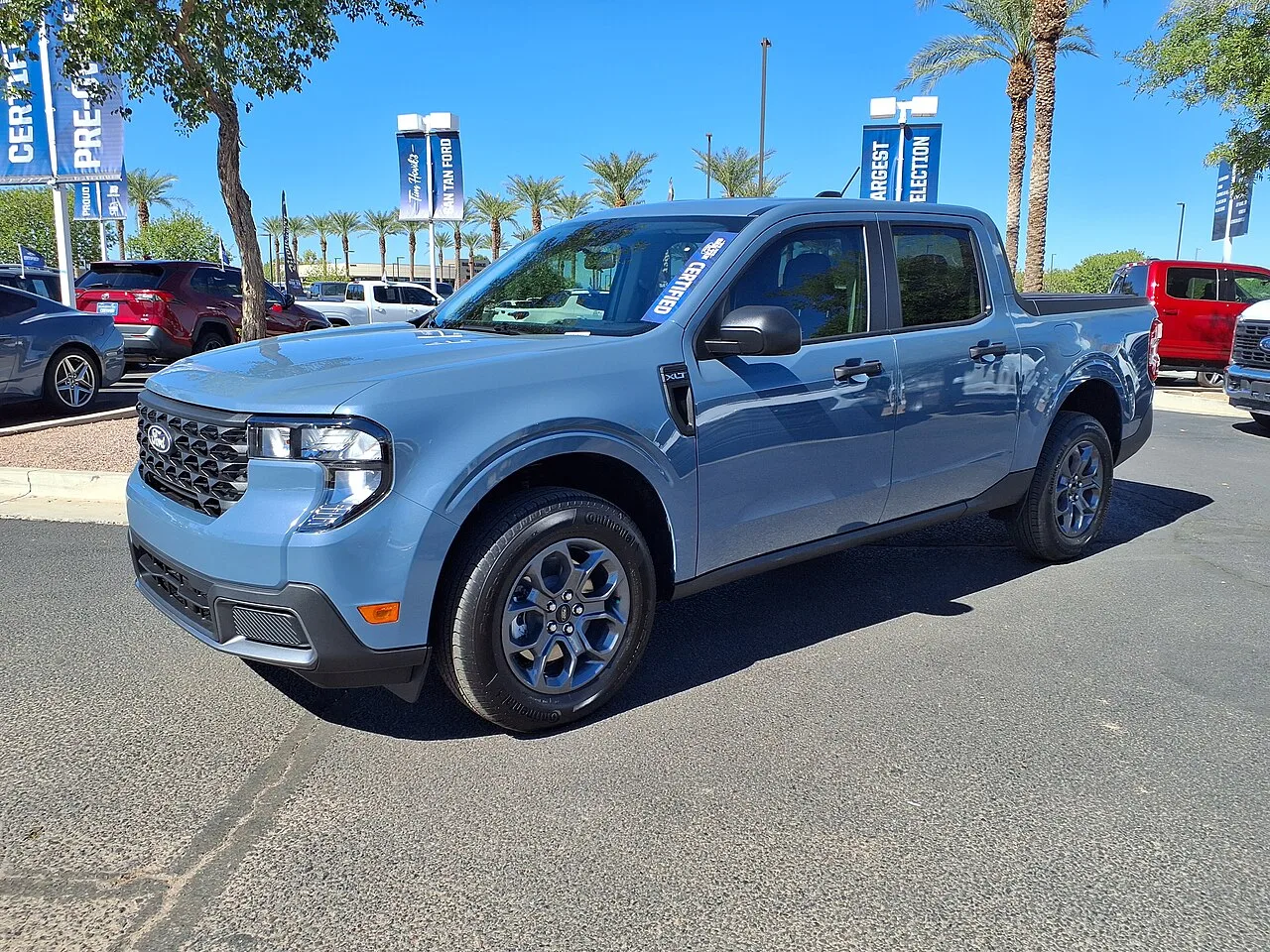
This Ford Maverick vs Hyundai Santa Cruz comparison uses the 2026 U.S. lineups. It focuses on commuting, weekend loads, and occasional towing rather than declaring a universal winner. Photographs include earlier model years and are labeled; their equipment should not be assigned to a 2026 purchase.
A facelifted 2025 Maverick XLT illustrates the design used in the current model family. Check 2026 powertrain and equipment separately. Photo: HJUdall; CC0. Converted to WebP by RecallWire; original framing retained.

Understand the powertrain difference
The 2026 Maverick lineup includes hybrid and EcoBoost gasoline choices. The 2026 Santa Cruz lineup uses gasoline engines: Hyundai lists a 191-hp 2.5-liter engine for SE, SEL, and SEL Activity, and a 281-hp turbocharged 2.5-liter engine for XRT and Limited. Santa Cruz is not a conventional-hybrid alternative to the Maverick Hybrid.
| Buying priority | Maverick question | Santa Cruz question |
|---|---|---|
| Hybrid commuting | Which hybrid drivetrain and trim fit? | Does a gasoline configuration meet the cost target? |
| Higher performance | Which EcoBoost configuration is relevant? | Is the turbocharged trim worth its complete premium? |
| Cargo use | Does the bed and tailgate arrangement fit the load? | Do the bed and storage features fit better? |
| Towing | Does the exact truck have required equipment and limits? | The same question, with Hyundai documentation |
| Daily family use | Test rear-seat and child-seat fit | Repeat the same test with the same occupants |
Choose the powertrain before comparing headline fuel economy or price. A front-wheel-drive hybrid Maverick and a turbocharged AWD Santa Cruz are different configurations. The comparison can be useful, but it should reflect what each choice costs and provides.
Translate fuel economy into annual spending
Ford lists 38 EPA-estimated combined mpg for the Maverick XL’s FWD hybrid configuration. Hyundai lists 25 combined mpg for 2026 Santa Cruz SE, SEL, and SEL Activity FWD; 24 for their AWD versions; and 20 for XRT and Limited AWD. Check the actual vehicle’s label before purchase, especially if choosing another Maverick drivetrain.
At an assumed 12,000 annual miles and $3.50 per gallon, these selected examples produce the following energy-only comparison:
| Selected configuration | Combined mpg | Calculated annual gasoline cost |
|---|---|---|
| Maverick XL FWD Hybrid | 38 | $1,105 |
| Santa Cruz SE FWD | 25 | $1,680 |
| Santa Cruz XRT AWD turbo | 20 | $2,100 |
Formula: miles ÷ mpg × gasoline price, rounded to the nearest dollar. Efficiency inputs come from Ford’s XL specification page and Hyundai’s 2026 page. Mileage and gasoline price are editorial assumptions, not averages or forecasts.
The selected FWD examples differ by about $575 a year in this scenario. The turbo AWD example answers a different equipment and performance question. Neither difference proves a total ownership winner: prices, insurance, tires, financing, and the usefulness of each configuration still matter.
If fuel spending is central, put your own mileage into the calculation. A low-mileage owner may reasonably prioritize cabin or bed fit, while a high-mileage commuter should examine the hybrid option closely.
Graphic: RecallWire calculation using the named manufacturer EPA combined ratings and the assumptions in the preceding table. Powertrains and drivetrains differ; this is not a total-cost ranking.
Measure the cargo instead of choosing a truck image
Ford lists a 54.4-inch bed floor length for the Maverick. That is a useful dimension, but it cannot establish that your specific furniture, tools, bicycles, or gardening supplies will load securely.
Measure the longest and widest regular items. Check floor length, wheel-well clearance, bed depth, tie-down locations, and tailgate positions in each truck. Consider how you will load a heavy item and whether it needs additional support or a ramp.
Santa Cruz’s bed arrangement and storage equipment deserve a hands-on check. Confirm which covers, compartments, and accessories are included on the specific trim; an attractive demonstration on a higher trim may not describe the vehicle in your quote.
A short bed can be highly useful for dirty or bulky cargo that you do not want in the cabin. It can also require compromises for long items. Choose according to the loads you repeatedly move, not the rare task that would require renting a larger truck anyway.
Verify towing equipment before paying for it
Towing capacity varies by configuration and required equipment. Use Ford’s 2026 towing guide for the Maverick and the applicable Hyundai owner’s documentation for the selected Santa Cruz. Do not assume a receiver hitch makes every example equivalent.
Write down the trailer’s loaded weight, hitch load, passengers, gear, and any installed accessories. Check vehicle and axle limits as well as the configured trailer rating. A package can be necessary for a particular rating without removing the need to check carrying capacity.
Here is a simple hypothetical screening exercise. If a vehicle label allows 1,400 lb of occupants and cargo, a planned 500 lb of people, 250 lb of gear and added equipment, and 350 lb of applicable hitch load leave 300 lb before any other relevant items. This is arithmetic using assumptions, not a Maverick or Santa Cruz rating or towing approval.
If the intended load uses almost all the available allowance, obtain an evaluation of the complete setup. If neither configuration meets the requirements comfortably, move to a different vehicle class instead of selecting the larger advertised number of the two.
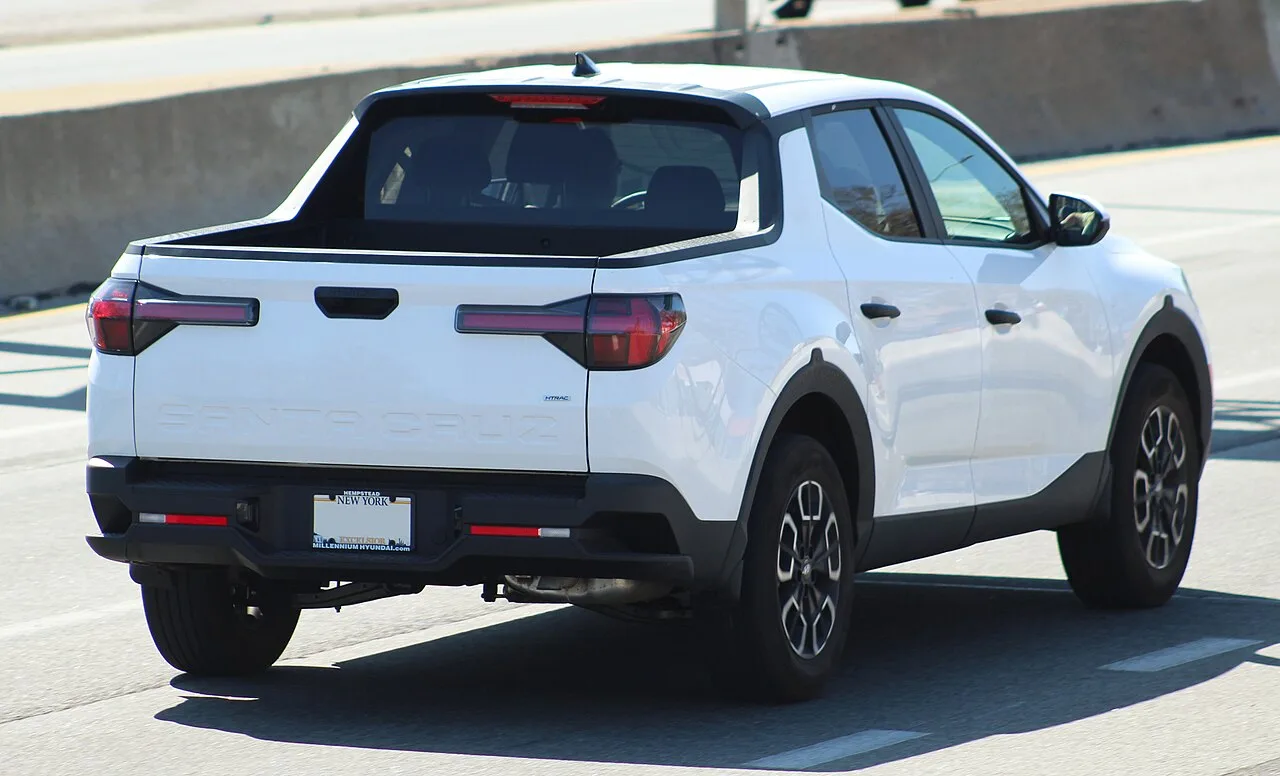
Photo: Kevauto; CC BY-SA 4.0. Converted to WebP by RecallWire; original framing retained.

Make the rear seat and parking space part of the test
Small pickups attract buyers who want an open bed without a full-size truck’s everyday footprint. Test that benefit in the spaces where you actually park. Check the turning and sight lines during a normal safe drive, and measure your garage or assigned space if clearance is close.
Inside, set the driver’s seat correctly before judging rear-room usefulness. Bring child seats or ask the adults who regularly ride with you to try entry and the rear seating position. A four-door body does not guarantee that every family’s seating combination works.
Assess cabin storage when the bed is occupied. Bags, laptops, shopping, and wet work gear may need separate places. Decide whether the chosen bed cover or storage features provide the weather protection and security you expect.
Try routine controls while parked. The layout you find easiest on a busy weekday may matter more than a small power difference. Evaluate seat comfort and noise on representative roads, without claiming a brief dealer drive proves long-term comfort or durability.
Compare equipment and complete ownership costs
Ask for itemized quotes for the two configurations that passed the practical tests. Include required packages and accessories rather than comparing a bare starting price with a fully equipped alternative.
Get insurance quotes and replacement tire prices for those vehicles. Review the maintenance schedules and actual warranty booklets, including transfer terms if used. The FTC’s warranty guide provides context for distinguishing a warranty from an added service contract.
For safety, confirm installed assistance functions and applicable IIHS ratings. Optional equipment and model-year qualifications should remain visible. An outdoors-oriented name or appearance does not establish crash protection, traction capability in every condition, or towing equipment.
RecallWire’s 2026 value-vehicle guide includes the Maverick in a broader shortlist. This pairwise comparison asks a narrower question: whether its verified configuration fits your needs better than the Santa Cruz you can actually buy.
Check campaigns without turning them into a ranking
Search the exact VIN with NHTSA and the manufacturer for either truck. Review relevant instructions and retain remedy records. A model comparison is not a substitute for those checks.
RecallWire’s small joint-tightening campaign includes certain 2026 Mavericks among a limited group of Ford vehicles. The reported population is 23 vehicles across the campaign. It does not mean every Maverick is affected, and it does not establish that a Santa Cruz has no outstanding recall.
For a used candidate, review maintenance and repair history separately. Ask whether towing accessories were added and whether the vehicle’s documentation and load limits match its installed equipment. Seller descriptions such as “tow ready” should lead to documents, not replace them.
Our VIN lookup guide explains the recall-search task. Keep its result alongside the inspection and purchase paperwork so each piece of evidence answers the question it actually covers.
Photo: Bull-Doser; Public domain. Converted to WebP by RecallWire; original framing retained.


Choose the small pickup around repeated use
Favor the Maverick Hybrid when your mileage makes its selected efficiency attractive and the truck’s verified equipment, cabin, and bed pass the practical checks. Compare other Maverick configurations separately when performance or a particular package is essential.
Favor the Santa Cruz candidate when its interior and cargo arrangement fit better and you accept the selected gasoline configuration’s fuel and purchase costs. Evaluate the turbo upgrade as an equipment and performance purchase, not a free addition to an entry model’s price.
If both work, make the final choice using the complete quote, service access, insurance, and the details you will touch daily. If towing is the deciding job, choose only after the exact load and configured limits are established.
A small pickup is most convincing when its open bed improves ordinary life without requiring you to buy capability you rarely use. Your comparison should end with that practical explanation.
Sources and methodology
Source review: October 6, 2026. Manufacturer specifications apply to the stated model year and configuration. Illustrative calculations are identified beside the data. This guide synthesizes published documentation; it does not report hands-on vehicle testing.
Selected 2026 pickups: modeled annual fuel cost
Maverick XL FWD Hybrid · 38 mpg: $1,105; Santa Cruz SE FWD · 25 mpg: $1,680; Santa Cruz XRT AWD turbo · 20 mpg: $2,100. See the visible article table for assumptions and sources.
USD/year · 12,000 miles/year · $3.50/gallon · powertrains and drivetrains differ. Energy only. This is not an equipment-matched or total-cost ranking.
View data table
| Label | Cost | Note |
|---|---|---|
| Maverick XL FWD Hybrid · 38 mpg | 1105 | Selected configuration; see article assumptions and citations. |
| Santa Cruz SE FWD · 25 mpg | 1680 | Selected configuration; see article assumptions and citations. |
| Santa Cruz XRT AWD turbo · 20 mpg | 2100 | Selected configuration; see article assumptions and citations. |

Frequently asked questions
Is the Santa Cruz a hybrid?
The cited 2026 U.S. lineup uses gasoline engines. It should not be treated as the same powertrain choice as a Maverick Hybrid.
Which one uses less fuel?
The selected Maverick FWD Hybrid has a higher EPA combined rating than the Santa Cruz configurations in the table. Other drivetrains require their own labels; total ownership cost also depends on more than fuel.
Can I use the maximum towing number for any trim?
No. Verify the powertrain, drivetrain, required equipment, load labels, and all applicable limits on the actual vehicle.
Sources used for this guide.
- Ford. 2026 Maverick models. Accessed October 6, 2026.Source ↗
- Ford. Maverick XL specifications. Accessed October 6, 2026.Source ↗
- Hyundai. 2026 Santa Cruz specifications. Accessed October 6, 2026.Source ↗
- Ford. 2026 RV and Trailer Towing Guide. Accessed October 6, 2026.Source ↗
- IIHS. Vehicle ratings. Accessed October 6, 2026.Source ↗
- NHTSA. Recall information. Accessed October 6, 2026.Source ↗