New CAFE Rule Slows the 2031 Fuel-Economy Climb
NHTSA’s final standards for model years 2027 through 2031 ease the prior federal trajectory. The change matters most in automakers’ product planning, while buyers should still assess each vehicle’s actual fuel costs and
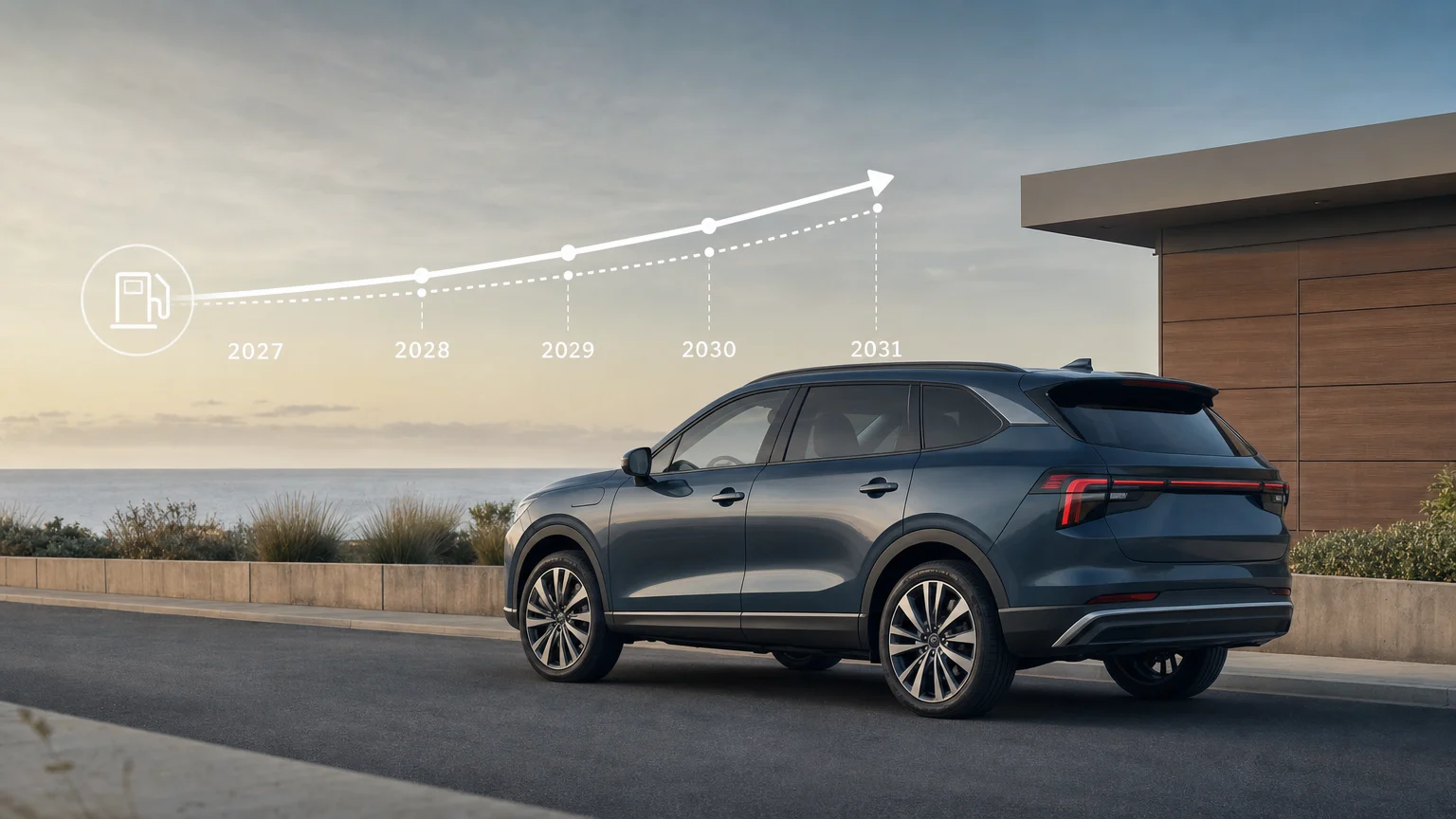
The National Highway Traffic Safety Administration has finalized new Corporate Average Fuel Economy standards for passenger cars and light trucks for model years 2027 through 2031. The rule replaces the steeper path adopted in 2024 and changes the compliance assumptions that automakers use when planning future powertrains, vehicle mix and fuel-saving technology.
The practical effect will not be an overnight change in the vehicles on dealer lots or in a vehicle’s window-sticker fuel-economy rating. CAFE is a manufacturer compliance program, not a promise that every vehicle will achieve one particular miles-per-gallon figure. Still, the new standards give automakers more room than the prior rule, particularly in the truck-heavy U.S. market, and reduce one regulatory reason to pursue a particular mix of hybrids, EVs and conventional vehicles.
The rule resets the federal trajectory for 2027 through 2031
NHTSA’s final rule sets CAFE requirements for passenger cars in model years 2027 through 2031 and for light trucks through the same period. According to the agency, the standards rise by 2% annually for passenger cars from model year 2027 onward. Light-truck standards remain flat in model years 2027 and 2028, then rise by 2% annually in model years 2029 through 2031.
That timing is central to the policy change. The Department of Transportation describes the final rule as less stringent than the standards finalized in 2024. The 2024 rule had established annual increases for cars and light trucks beginning earlier in the compliance period. The newer rule therefore changes the regulatory baseline against which manufacturers make long-cycle investment decisions.
NHTSA projects that the final standards correspond to an industrywide light-duty fleet average of about 34.5 mpg in model year 2031. That figure should not be read as a window-label rating, a requirement for every model, or an estimate of what any individual driver will experience. CAFE calculations are based on manufacturer fleets, vehicle categories and statutory test procedures that differ from the EPA estimates shown to shoppers.
For consumers, the immediate implication is limited. A 2027 vehicle’s price, fuel use and equipment will still depend on the program the automaker had already developed, as well as component costs, competition and consumer demand. The more important effects will emerge as manufacturers decide what to engineer into later products.
A slower standard does not eliminate efficiency pressures
The new federal rule reduces the compliance burden relative to the 2024 framework, but it does not remove fuel economy as a product issue. Automakers still must meet fleet standards, and fuel consumption remains a meaningful ownership cost for buyers who drive frequently or face volatile gasoline prices.
Manufacturers also sell into markets with different regulations and consumer expectations. A company can have commercial reasons to offer hybrids, efficient gasoline engines, EVs or aerodynamic improvements even if the U.S. CAFE requirement is less aggressive. Those reasons include operating-cost competition, emissions rules outside the federal CAFE program, corporate fleet demand and the need to spread engineering costs across global vehicle programs.
That distinction matters when evaluating claims that a revised CAFE rule will automatically make vehicles less expensive. DOT projects consumer savings and lower compliance costs from the final standards. Those are agency projections, not guaranteed transaction-price reductions for a particular model. Vehicle pricing also reflects labor, materials, tariffs, interest rates, dealer inventory, incentives and each manufacturer’s market strategy.
Buyers should therefore continue to compare the official label economy or energy-use rating of the specific vehicles they are considering. A less stringent fleet rule does not make a fuel-efficient vehicle less useful to an owner whose budget is sensitive to operating costs.
The policy changes compliance planning more than showroom labels
CAFE standards are set separately for passenger cars and light trucks, with targets that vary by vehicle footprint. That structure means a manufacturer’s compliance position is shaped by the mix of vehicles it sells, not simply by the rating of one popular model.
The final rule also addresses the treatment of CAFE compliance credits. Credits remain an important regulatory tool because they can allow a manufacturer to balance overcompliance in one period against a shortfall in another, subject to the program’s rules. The details of credit treatment matter most to corporate compliance departments and companies whose product plans rely heavily on a narrow set of efficient vehicles.
For shoppers, this is one reason not to treat regulatory targets as direct product forecasts. A company might respond to the new standards with more conventional powertrains, more hybrids, smaller vehicles, improved transmissions or a different sales mix. Another company could continue investing aggressively in EVs because of its customers, product positioning or broader market strategy. The rule expands flexibility; it does not dictate a single technical answer.
The model-year lead time is also significant. Automobiles are developed years before launch, and changes to engines, batteries, platforms and supplier contracts cannot always be made quickly. As a result, the first visible impact is likely to be in future product planning and compliance forecasts rather than a sudden redesign of current vehicles.
What the change means for a U.S. vehicle buyer
The clearest takeaway is that federal policy is now asking less of automakers than the 2024 CAFE rule would have required over this period. That may influence the availability and pricing of future powertrains at the margins, especially for trucks and SUVs. It does not establish that any individual buyer should avoid, or choose, a hybrid, EV or gasoline vehicle.
A hybrid can make sense for drivers who want lower fuel use without relying on public charging. An EV can be compelling for households with dependable charging and a driving pattern that fits its range and charging time. A conventional gasoline vehicle may remain the appropriate choice where upfront price, towing needs, rural travel or charging access carry more weight. Those are ownership questions that CAFE compliance figures cannot answer on their own.
Shoppers should focus on the specific vehicle’s purchase price, rated economy or energy consumption, expected fuel or charging expense, warranty coverage, capability and resale outlook. The revised rule changes incentives behind future offerings, but it does not substitute for comparing the actual vehicles available in a buyer’s market.
A meaningful regulatory shift with gradual consumer effects
NHTSA’s final 2027–2031 CAFE standards are a substantive reversal from the steeper federal path set in 2024. The biggest near-term consequence is a new planning environment for automakers, particularly as they allocate investment among conventional engines, hybrids and EVs.
For consumers, the rule is context rather than a shopping shortcut. Fuel efficiency will remain relevant to operating costs and vehicle value even under slower federal increases. The most reliable decision remains a vehicle-by-vehicle comparison grounded in official ratings, price and the owner’s real driving needs.
Sources used for this analysis.
- National Highway Traffic Safety Administration. Final Rule: CAFE Standards for MYs 2027-2031 Passenger Cars and Light Trucks. Accessed September 28, 2026.Source ↗
- U.S. Department of Transportation. President Trump & Transportation Secretary Sean P. Duffy Unveil New “Freedom Means Affordable Cars” Initiative. Accessed September 28, 2026.Source ↗
- U.S. Department of Transportation. Federal Register Documents: 2025-22014. Accessed September 28, 2026.Source ↗
- U.S. Department of Transportation. USDOT Finalizes New Fuel Economy Standards for Model Years 2027-2031. Published June 7, 2024. Accessed September 28, 2026.Source ↗